


If you've ever wondered why two gold-looking pieces of jewelry have drastically different prices or why some fade quickly while others last for years. The answer often lies in what’s beneath the surface. Today, we're breaking down the different types of gold jewelry so that can help you make smarter, longer-lasting jewelry purchases.
Let's start with a quick comparison so you get the general ideas.

Now let's dive into the details of each type so you can learn more about them.
1. Gold Plated: The Most Common and Most Fragile Option
Gold-plated jewelry is made by applying a very thin layer of gold, usually 0.5 microns thick or less, over a base metal which is often brass, copper or even nickel-based alloy. The coating process is done by submerging the base metal into an electrically charged solution long enough for gold ions to bond to it—this is the process of electroplating.
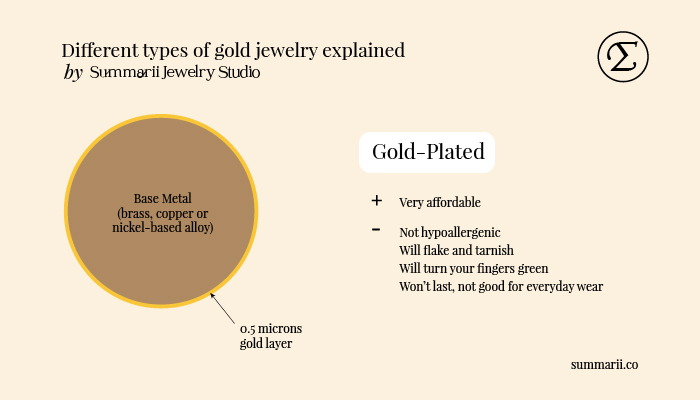
Gold-plated jewelry is usually sold in the fast fashion industry as it’s very affordable and only lasts for weeks or months with regular wear. It’s also very prone to fading, flaking, scratching, and tarnishing—it’ll probably also discolor and turn your skin green. It’s not hypoallergenic as it may cause skin irritation, especially for sensitive skins.
In short, gold-plated jewelry is budget-friendly and good for some trendy pieces that you’ll wear only a few times. Don’t expect it to be a long-term staple, it’s not meant to be worn everyday.
2. Gold Vermeil: The Smart Luxury Alternative
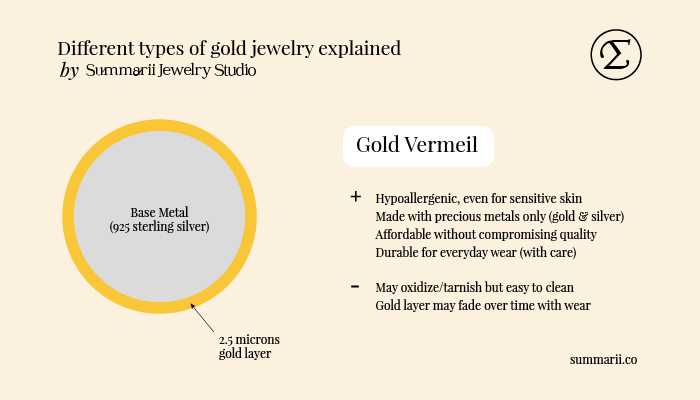
Vermeil is a French word that means silver-gilt. Gold Vermeil (commonly pronounced "ver-may" in English) is a type of jewelry that uses sterling silver (92.5% pure silver) as base metal, which is then coated with a thick layer of at least 2.5 microns gold by electroplating.
To legally be called gold vermeil in most markets (especially in the U.S. and EU), the jewelry must meet the following key standards:
- Base Metal: Must be sterling silver, not brass or any other cheaper metal, no nickel.
- Gold Purity: The gold used is at least 10 karats (often higher, like 14k, 18k, or even 24k).
- Gold Thickness: The gold layer must be at least 2.5 microns thick — much thicker than regular gold plating.
Now that you know the basics of gold vermeil jewelry, let’s breakdown its pros and cons so you can make better purchase decisions.
Pros:
- Hypoallergenic: Gold vermeil is made with precious metals only—no brass, no copper, no nickel. This means that gold vermeil won’t cause any irritations, even for sensitive skin.
- Affordable pricing: It offers a rich and luxurious look just like solid gold, but at a fraction of the price.
- Suitable for Everyday Wear: It’s durable enough for regular wear (with care!)
Cons:
- Due to its sterling silver base, gold vermeil jewelry may tarnish overtime if left in a open air. Luckily you can clean off the dark spots with a silver polishing cloth.
- Depending on how often you wear your jewelry, the gold layer may face away over time. This is a normal and natural process that will occur with all types of plated jewelry since it’s not solid gold.
3. Gold Filled: Great Durability, but Limited Elegance
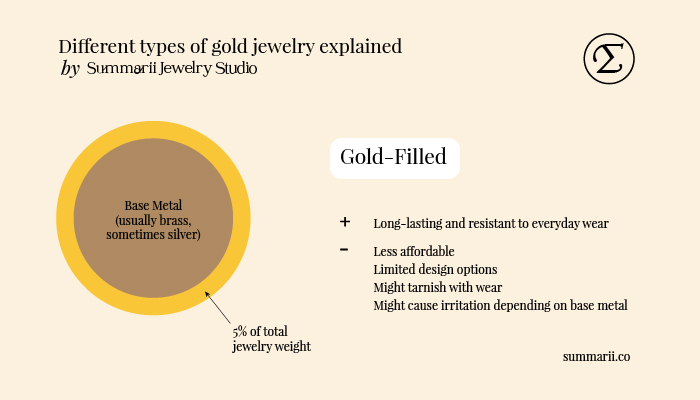
Gold-filled jewelry has a mechanically bonded thick layer of gold (usually 5% by weight) over a base metal usually brass or copper. It's generally considered to be hypoallergenic, but people with sensitive skin may still experience irritation due to its base metal not being hypoallergenic.
Gold-filled jewelry is tarnish resistant and more durable which makes it a great choice for everyday wear. However, due to its production process, gold-filled jewelry has limited design options since it can’t be cast or molded.
Pros:
- Gold-filled jewelry is more long-lasting and more resistant to everyday wear than gold plated or gold vermeil. But bear in mind that this is not solid gold so the gold layer might fade overt time with wear.
Cons:
- The base metal is usually brass or copper which can cause irritations. Sometimes sterling silver is used as base metal, but the price of this type of gold-filled will significantly increase.
- Designs are often bulkier or less refined due to its production process.
- Gold-filled jewelry are often more expensive than gold plated and gold vermeil.
4. Solid Gold: Timeless, Precious and Truly Forever
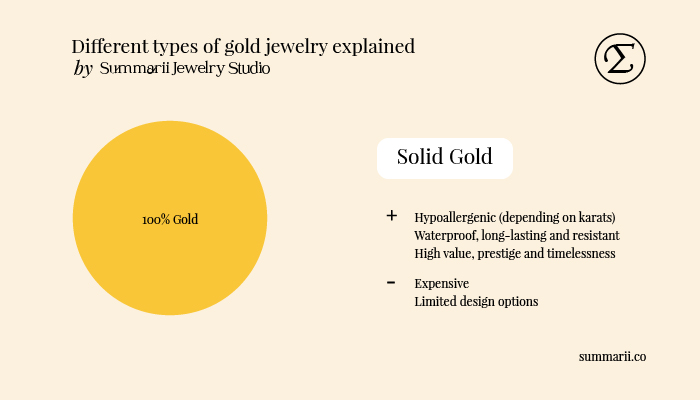
Solid gold jewelry is exactly what it sounds like—jewelry made entirely (or mostly) of real gold, not just coated on the surface.
It’s measured in karats (K), with 24K being pure gold. However, most jewelry is made with 14K or 18K gold, which combines gold with other metals for added strength because pure gold is too soft and malleable that it can bend or scratch easily.
Solid gold is the most luxurious and durable option but also the most expensive. It's best for those who want forever pieces—classic, meaningful, and investment-worthy. It’s not just jewelry, it’s legacy.
Pros:
- Will never tarnish or fade
- Safe for all skin types (especially 14K and higher)
- Can last for decades or even generations
- Retains value over time
- Ideal for heirlooms or investment pieces
Cons:
- Comes with a high price tag
- Softer karats (like 22K or 24K) can be prone to scratching
- Limited design options
5. Why Summarii Chooses Gold Vermeil and What's the Best Option for You?
At Summarii, we believe in giving our customers the beauty of real gold, the trust of precious metals, and the value of affordability—without compromising your skin, your style, or your standards. That's why we choose to offer a wide range of gold vermeil jewelry. It offers the rich look and feel of solid gold, but at a fraction of the price. It’s perfect for everyday elegance, and it’s one of the best values in the demi-fine jewelry world.
Every of our vermeil pieces are handmade with 925 sterling silver then coated with a thick, warm layer of real gold. They are designed to be your everyday best friend.
If you want to invest in jewelry that looks luxurious, wears beautifully and won't break the bank, gold vermeil can be your golden middle ground. But of course, the best option is the one that suits you depending on different factors such as your budget, frequency of wear, how often you can take care/clean your jewelry, and more.
We hope this post helped you understand the different types of gold jewelry that are available on the current jewelry market. To find the best option for you, you should do your own research and then make more sustainable choices. Feel free to check out our gold vermeil and sterling silver jewelry collections for your everyday wear.